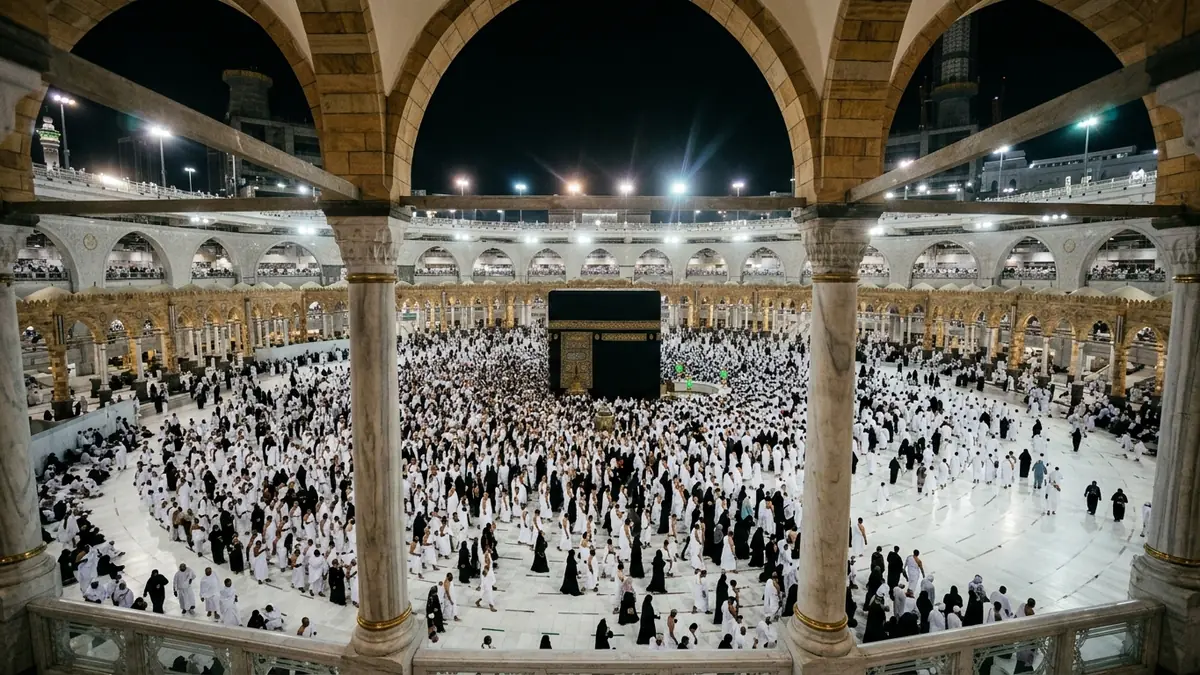
Umrah is an Islamic pilgrimage to Makkah that Muslims can perform at any time of the year. It has four pillars: Ihram, Tawaf, Sa'i and Halq or Taqsir.
What Is Umrah?
Umrah (Arabic: عُمْرَة, 'to visit a populated place') is an Islamic pilgrimage to Makkah (Mecca), in the Hejazi region of Saudi Arabia. Muslims can perform Umrah at any time of the year, unlike Hajj, which falls on fixed dates in the month of Dhu al-Hijjah. During the Hajj season, the Saudi government restricts entry to Makkah to Hajj permit holders only. Umrah is sometimes called the 'lesser pilgrimage' compared with Hajj, but performing Hajj or Umrah is an act of worship that holds deep spiritual weight. The Hanbalis and the Shafi'is regard it as obligatory. Umrah has 4 pillars (arkan): Ihram, Tawaf, Sa'i and Halq or Taqsir. It has 7 steps in total: ghusl, Ihram garments, Talbiyah, Tawaf, two rak'ahs at Maqam Ibrahim, Sa'i and cutting the hair. Most pilgrims complete the rites in 3 to 6 hours.
Umrah is not to be confused with Ummah (the global Muslim community). Hajj is prescribed in the Quran as one of the 5 Pillars of Islam. Umrah is not, though the Hanbalis and Shafi'is still regard it as obligatory. This page covers the rites, history, Ramadan Umrah, administration and how Umrah differs from Hajj.
Umrah from the UK starts from £500 per person for a 7-night package with flights, visa and hotel. We arrange departures from London, Manchester and Birmingham year-round, with hotel stays in both Mecca and Medina.
Rites and Rituals of Umrah
Umrah requires 4 rites performed in sequence. Each rite has its own conditions and supplications.
Ihram (State of Consecration)
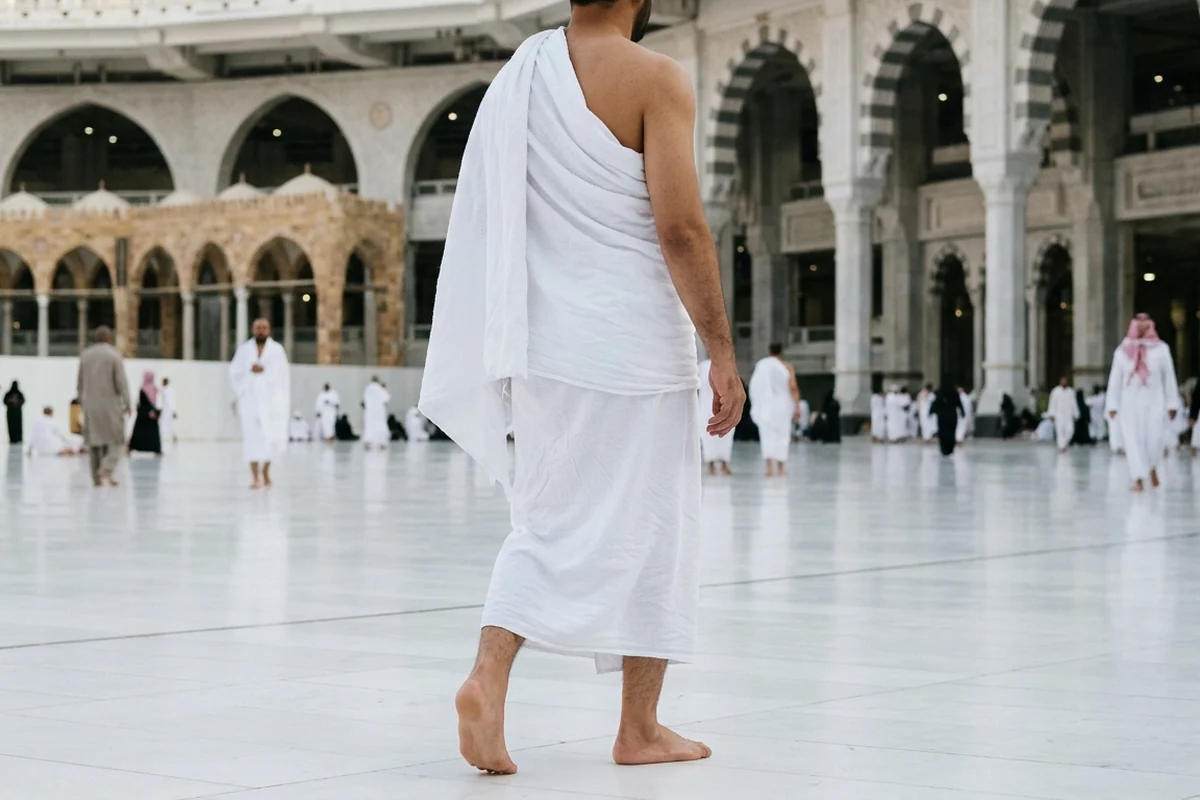
Ihram is a state of ritual purity that a Muslim must enter before reaching a Miqat (boundary point) on the routes into Makkah. There are 5 principal Miqat points:
- Dhu al-Hulayfah — 433 km (269 miles) north of Makkah, used by pilgrims from Madinah (Medina)
- Al-Juhfah — used by pilgrims from the Levant
- Qarn al-Manazil — 80 km (50 miles) north-east, used by pilgrims from Najd
- Yalamlam — about 85 km (53 miles) south-west, used by pilgrims from Yemen
- Dhat Irq — used by pilgrims from Iraq
- Ibrahim Mursiyah — used by pilgrims already near Makkah
The pilgrim then recites the Talbiyah (devotional proclamation) aloud (men) or quietly (women): Labbayka Allahumma labbayk. Labbayk la shareeka laka labbayk. Inna al-hamda, wa n-ni'mata, laka wal mulk. La shareeka lak.
'Here I am, O Allah, here I am. You have no partner; here I am. All praise, blessing and sovereignty are Yours. You have no partner.'While in Ihram, the pilgrim must avoid scented products, cutting hair or nails, covering the head (men), wearing sewn garments (men), and marital relations. Passing the Miqat without Ihram requires a fidyah (sacrifice).
Tawaf (Circumambulation of the Kaaba)
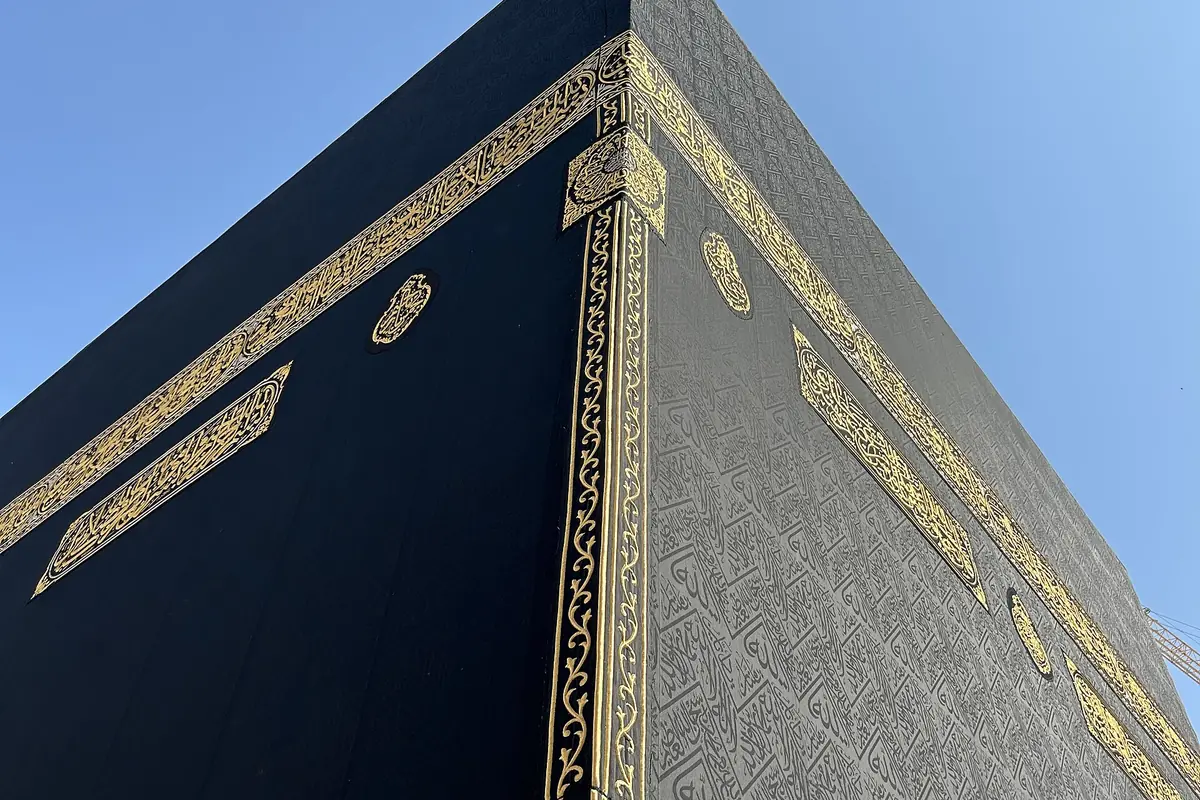
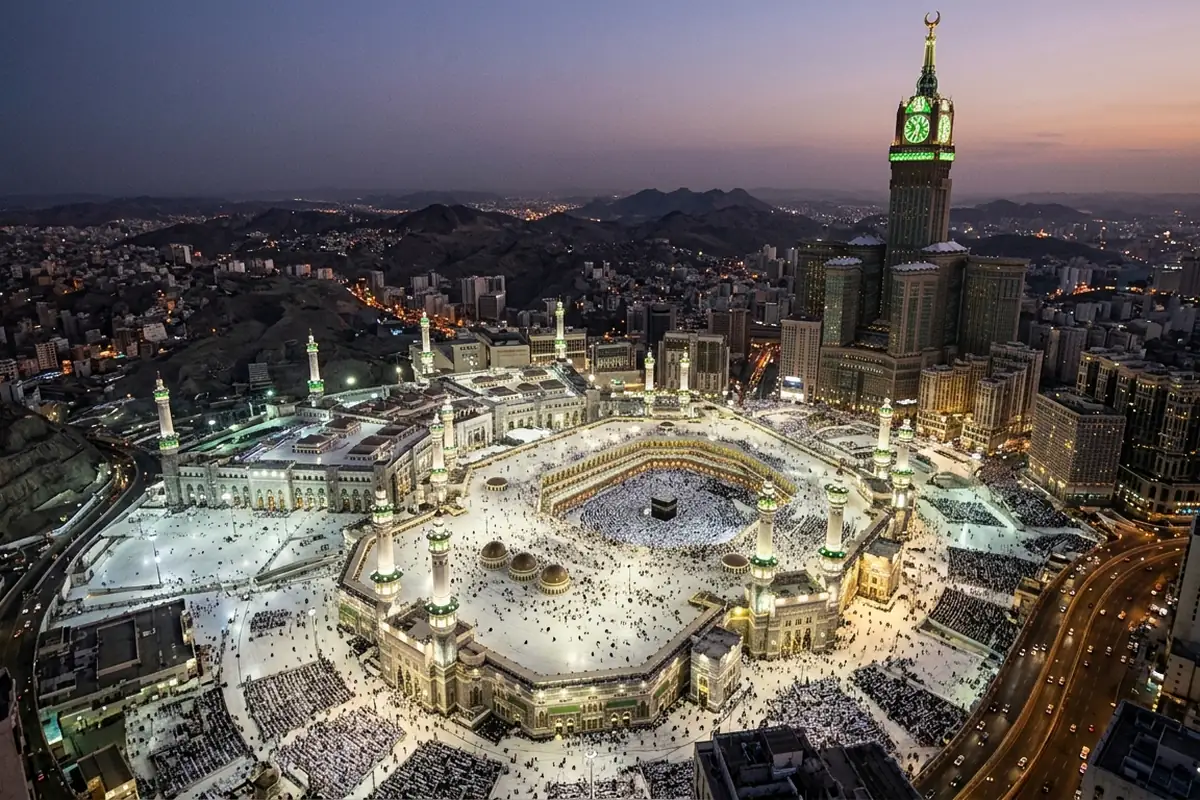
Tawaf is 7 anti-clockwise circuits around the Kaaba inside the Mataf at Masjid al-Haram, the Great Mosque of Makkah. Each circuit starts and ends at the Black Stone (Hajar al-Aswad).
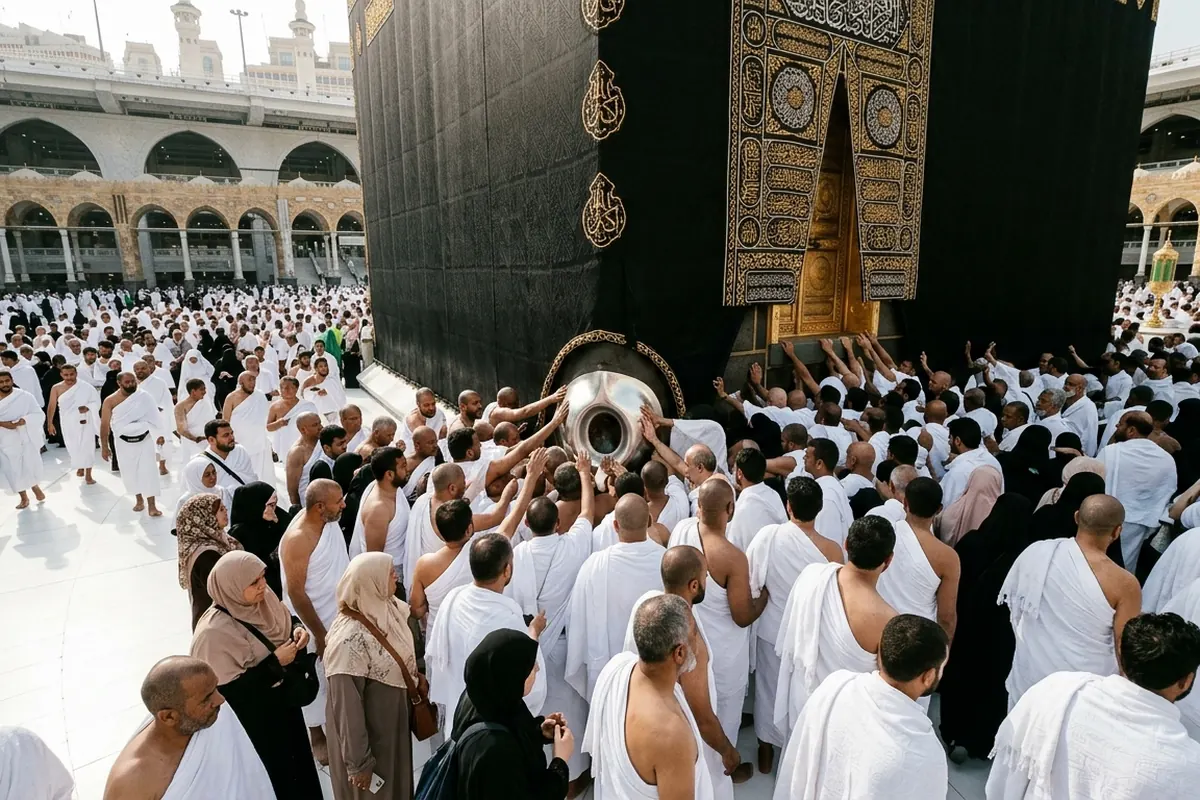
The Black Stone is 8 fragments assembled in a silver frame, set in the south-eastern corner of the Kaaba. When aligned with the stone, the pilgrim raises a hand and says 'Allahu Akbar'. A circuit begun before the Black Stone line does not count, even if short by a small distance.
Tawaf has 9 conditions. The pilgrim must be Muslim, of sound mind, with intention, covering the awrah and in a state of purity. The pilgrim must complete 7 full circuits, keep the Kaaba on the left, begin at the Black Stone, and stay inside the Masjid.
It is Sunnah for men to show the right shoulder (idtiba) during Tawaf and to walk briskly (ramal) during the first 3 circuits.
After completing Tawaf, the pilgrim prays 2 rak'ahs behind Maqam Ibrahim (the Station of Abraham). The Maqam stone itself is about 50 cm cubed, with two oval footprint depressions. The enclosing crystal structure is separate from the stone.
Sa'i (Walking Between Safa and Marwah)
Sa'i is 7 laps between the hillocks of Safa and Marwah inside the Mas'a gallery at Masjid al-Haram. The distance between Safa and Marwah is 394 m (1,293 ft); 7 laps total 2,761.5 m (about 2.8 km or 1.7 miles).
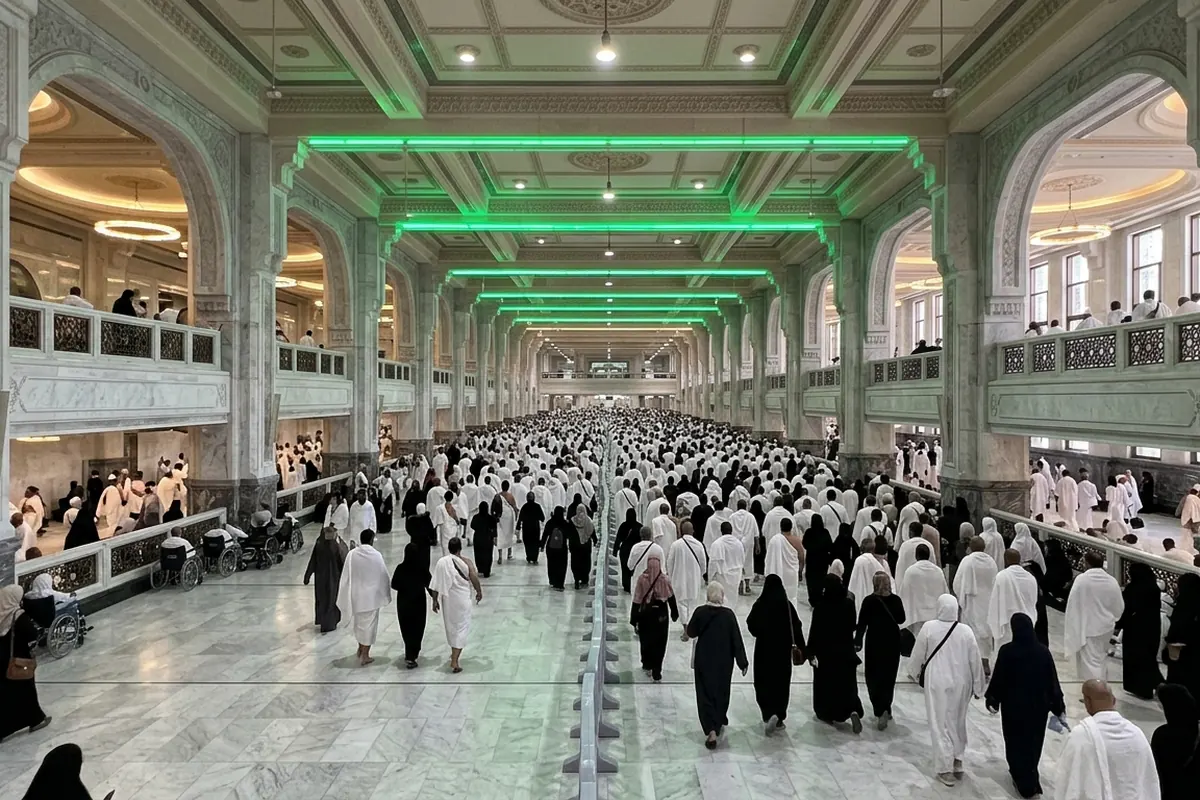
Sa'i commemorates Hagar's (Hajar's) search for water for her son Ishmael (Isma'il), and Allah's mercy in answering her prayers through the Zamzam Well. The pilgrim starts at Safa, walks to Marwah (1 lap), returns to Safa (2 laps), and continues until completing 7 laps, ending at Marwah.
Between the two green marker lights (covering about 55 m), men jog; women walk at their normal pace. Unlike Tawaf, continuity is not required in Sa'i — a break between laps is permitted.
Halq or Taqsir (Shaving or Trimming the Hair)
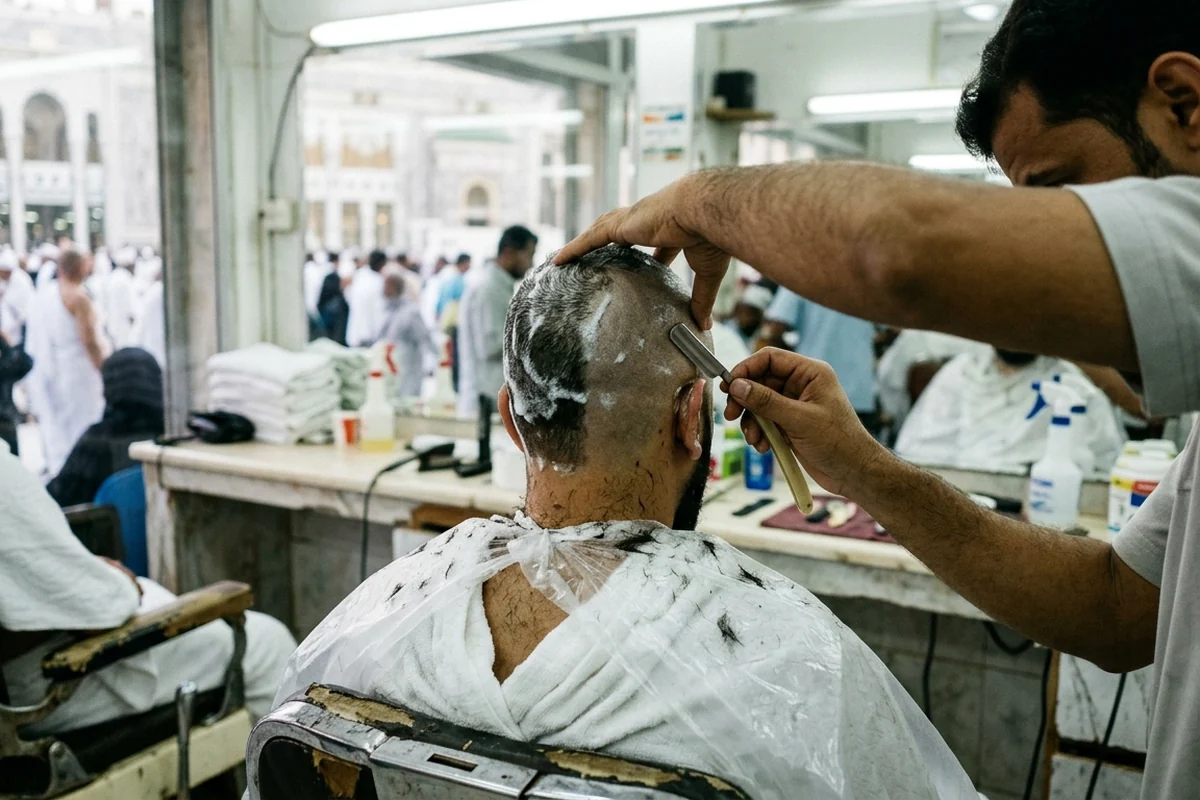
After completing Tawaf and Sa'i, the pilgrim exits Ihram by cutting the hair:
- Men: Halq (shaving the entire head) is preferred. The Prophet Muhammad (peace be upon him) supplicated 3 times for those who shave and once for those who trim.
- Women: Cut about 1 to 2 cm from the ends of the hair. Women do not shave.
History of Umrah
Umrah and Hajj are rooted in the history of Makkah and the early Muslim community. Access to the Kaaba was not always open to Muslims.
The Treaty of Hudaibiya
In 628 CE (6 AH), the Prophet Muhammad and about 1,400 followers set out from Madinah to perform Umrah, inspired by a dream. The Quraysh of Makkah — the local tribe to which Muhammad belonged — refused them entry at Hudaibiya, on the outskirts of the city.
Muhammad refused to use force out of respect for the sanctity of the Kaaba. Diplomatic negotiations followed. In March 628 CE (Dhu al-Qi'dah, 6 AH), the Treaty of Hudaibiya was signed. The terms set a 10-year truce and granted Muslims 3 days of access to the Kaaba per year, starting the following year. In the year the treaty was signed, the Muslims returned to Madinah without performing Umrah.
The First Umrah
The following year (629 CE), Muhammad and about 2,000 followers performed what became the first Umrah. Men, women and children took part, and the visit lasted 3 days. After the subsequent Conquest of Makkah, those who had persecuted the early Muslims were pardoned. Among those forgiven were Ikrimah ibn Abi Jahl, Abdullah ibn Saad ibn Abi Sarh and Habbar bin Aswad. Others pardoned included Miqyas Subabah Laythi, Huwairath bin Nuqayd and Abdullah Hilal.
COVID-19 Closures
On 26 February 2020, Saudi Arabia suspended travel for Umrah due to the spread of COVID-19. On 4 March 2020, the Saudi government banned Umrah for citizens, foreign visitors and residents. Umrah for international pilgrims resumed on 10 August 2021.
Administration and Digital Services
The Ministry of Hajj and Umrah manages Umrah permits, visas and bookings through digital platforms. In 2022, the Ministry launched Nusuk as the replacement for the Eatmarna application. Nusuk handles Umrah permits, visit and Umrah visas, and bookings for the Prophet's Mosque in Madinah.
In 2025, the Ministry launched Nusuk Umrah, a platform that allows pilgrims from abroad to apply directly for an Umrah visa and book services online. Accredited local agents remain available through the Nusuk Umrah system.
Umrah can be performed on 3 visa types. These are the Saudi tourist e-visa, the dedicated Umrah visa through Nusuk, and the electronic visa waiver. A dedicated Umrah visa is not the only route — the Ministry has confirmed that all visa types allow the holder to perform Umrah.
Umrah in Ramadan
Performing Umrah during Ramadan carries a reward equal to Hajj in merit, though it does not discharge the obligation of Hajj. This reward applies throughout the entire month, not only on Fridays. The Umrah must run from Ihram to completion within Ramadan. Entering Ihram at the end of Sha'ban and finishing the rites in Ramadan does not qualify.
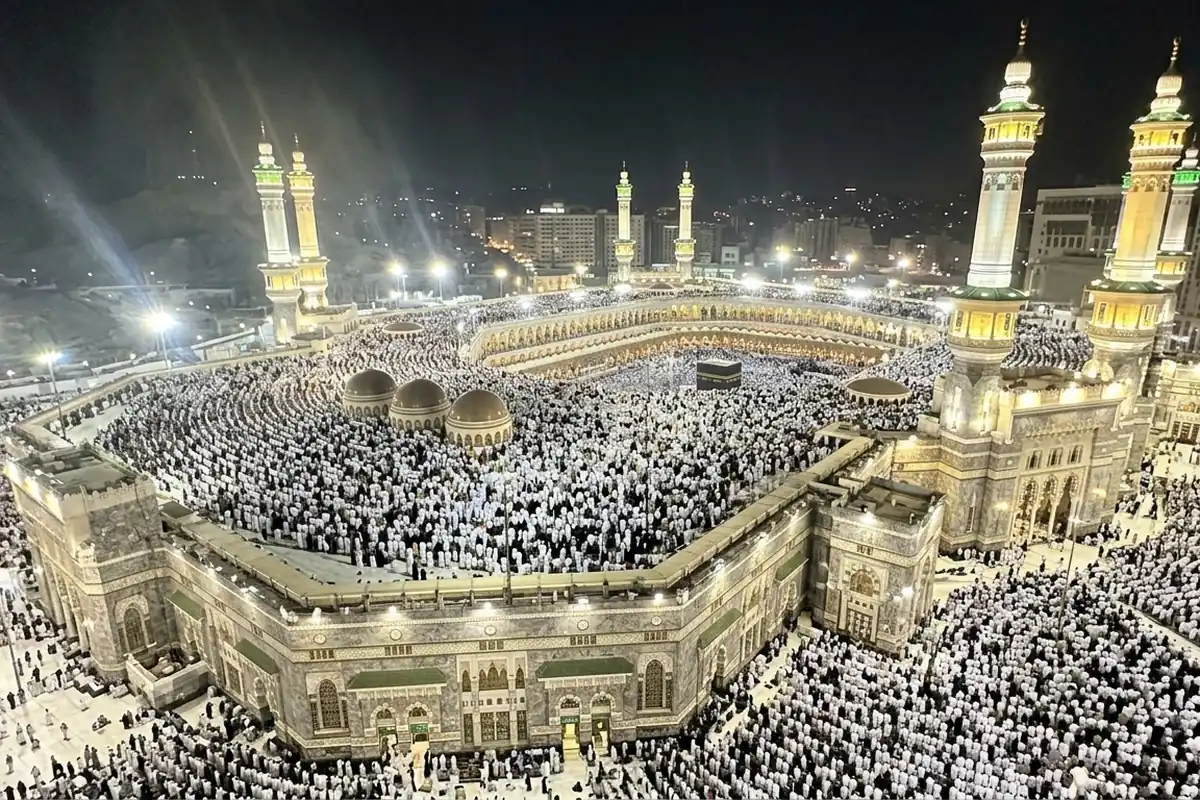
Ramadan is the busiest period for Umrah, and packages sell out early. We offer dedicated Ramadan Umrah packages from the UK.
Hajj and Umrah: the Difference
Hajj and Umrah are both pilgrimages to Makkah, but they differ in 3 ways: UmrahHajjObligationVoluntary (obligatory per Hanbalis and Shafi'is)One of the 5 Pillars of Islam — obligatory once in a lifetime for every Muslim who is physically and financially ableTimingAny time of the year, except during the Hajj season8th to 12th (or 13th) of Dhu al-Hijjah onlyDuration3 to 6 hours for the ritesSeveral daysRitualsIhram, Tawaf, Sa'i, Halq/TaqsirAll Umrah rites plus Mina, Arafat, Muzdalifah, Rami al-Jamarat (stoning), and the sacrifice
See Also
- Umrah Packages from the UK — 3-star, 4-star, 5-star and luxury options from £500 per person
- Umrah Visa Guide — how the Saudi e-visa and Nusuk Umrah visa work for UK pilgrims
- Ramadan Umrah Packages — dedicated Ramadan departures
- Makkah Hotels Guide — 3-star to 5-star hotels near Masjid al-Haram
- Madinah Hotels Guide — hotels near Al-Masjid an-Nabawi
- Hajj Packages — Air Travel Organiser's Licence (ATOL) protected Hajj from the UK
References
- Hawting, G. E. (2009). 'The Disappearance and Rediscovery of Zamzam and the Well of the Ka'ba'. Bulletin of the School of Oriental and African Studies, 43(1): 44–54.
- Sa'd, Muhammad Ibn (1972). Kitab Al-tabaqat Al-kabir. Pakistan Historical Society.
- Mubarakpuri, The Sealed Nectar, pp. 214–215.
- Bogle, Emory C. (1998). Islam: Origin and Belief. University of Texas Press, p. 19.
- Abu Khalil, Shawqi (2004). Atlas of the Prophet's Biography. Dar-us-Salam, p. 218.
- IslamQA 154979: 'How to Perform Umrah' — steps and pillars of Umrah.
- Saudipedia: 'What is Al-Masa'a' — Sa'i distance (394 m).
- Saudipedia: 'Miqat Dhu al-Hulayfah' — Miqat distances from Makkah.
- Saudipedia: 'The Black Stone' — 8 fragments in a silver frame.
- Saudi Gazette (28 September 2022): 'Hajj ministry replaces Eatmarna application with Nusuk'.
- Asharq Al-Awsat (21 August 2025): 'Saudi Arabia Launches Direct Umrah Visa Application Service'.
- Ebrahim, S. H. & Memish, Z. A. (April 2020). 'Saudi Arabia's drastic measures to curb the COVID-19 outbreak'. Journal of Travel Medicine, 27(3).
Book Your Umrah with Insha Travel
Insha Travel is an International Air Transport Association (IATA) certified UK Muslim travel agency. Every flight-inclusive Umrah package is Air Travel Organiser's Licence (ATOL) protected, and the Saudi visa cost is included in the package price. We arrange departures from London, Manchester and Birmingham year-round, with 3-star, 4-star, 5-star and luxury hotel options in Makkah and Madinah.
Umrah has 4 pillars — Ihram, Tawaf, Sa'i and Halq or Taqsir — and we handle everything around them. Browse our Umrah packages from £500 per person, or contact us to discuss your requirements.
Insha Travel holds ATOL protection and IATA accreditation, and works with Ministry-approved hotels and transport.
